Showing posts with label PipeNetworks. Show all posts
Showing posts with label PipeNetworks. Show all posts
For those of you not accustomed to visting Whirlpool - Australia's premier Broadband community forum - there was a great debate over the past two weeks between myself and the CEO of Pipe Networks, Bevan Slattery.
Bevan Slattery has been an enabler of Australia's broadband competitive landscape. Much of the DSL backhaul used by the likes of iiNet, Internet, Adam, Primus, TPG/Soul (and I would also imagine Optus and AAPT/Powertel) is carried over Pipe Network's dark fibre infrastructure. In 2006, his company won ATUG's "Carrier of the Year" award for its significant contribution to Australian business telecommunications.
But in a recent presentation Bevan made to the CommsDay Summit, he slammed the Government over the National Broadband Network; claiming it would cost in excess of $20b just for the backhaul alone, with another $28b for the cost of deploying the Nodes - a total of $48b. He further claims the Labour party is already "breaking its pre-election promises" and "watering down" the NBN after realising the "true cost" of the network was much larger.
Over the past two weeks we have conducted a robust and very public debate on Whirlpool regarding the real cost of the NBN. The debate was based on two critical issues; Coverage Area and Cost of Deployment.
Bevan claims the Government originally promised to deliver a minimum 12Mbps symmetrical service to 98% of the population, representing a coverage area a little over 1 million square kilometres. Based on this 343,728 nodes (at a cost of $85,000 each) would be needed to met the Government requirements; with 687,000 kilometres of new fibre backhaul connecting them to the Internet. This represented a total cost of $48b, significantly more than the $9.4b the Government (and others) has suggested.
As I highlighted in my article and several times during the debate, Bevan made three critical mistakes in his calculations:
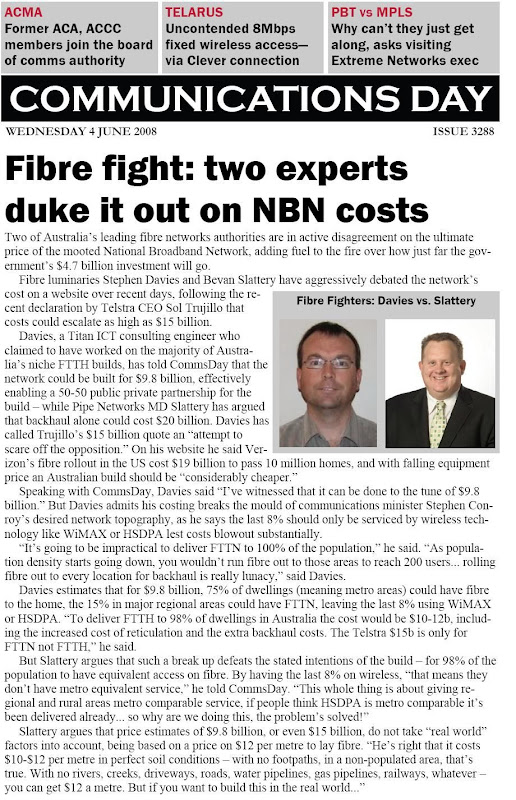
This debate went on for 10 days and was eventually picked up the CommsDay journalist Luke Coleman who published an article called the "Fibre Fight". Luke gave me permission to reprint this article.
Bevan Slattery has been an enabler of Australia's broadband competitive landscape. Much of the DSL backhaul used by the likes of iiNet, Internet, Adam, Primus, TPG/Soul (and I would also imagine Optus and AAPT/Powertel) is carried over Pipe Network's dark fibre infrastructure. In 2006, his company won ATUG's "Carrier of the Year" award for its significant contribution to Australian business telecommunications.
But in a recent presentation Bevan made to the CommsDay Summit, he slammed the Government over the National Broadband Network; claiming it would cost in excess of $20b just for the backhaul alone, with another $28b for the cost of deploying the Nodes - a total of $48b. He further claims the Labour party is already "breaking its pre-election promises" and "watering down" the NBN after realising the "true cost" of the network was much larger.
Over the past two weeks we have conducted a robust and very public debate on Whirlpool regarding the real cost of the NBN. The debate was based on two critical issues; Coverage Area and Cost of Deployment.
Bevan claims the Government originally promised to deliver a minimum 12Mbps symmetrical service to 98% of the population, representing a coverage area a little over 1 million square kilometres. Based on this 343,728 nodes (at a cost of $85,000 each) would be needed to met the Government requirements; with 687,000 kilometres of new fibre backhaul connecting them to the Internet. This represented a total cost of $48b, significantly more than the $9.4b the Government (and others) has suggested.
As I highlighted in my article and several times during the debate, Bevan made three critical mistakes in his calculations:
- Using population instead of Dwellings. The Labour Party policy document titled "New Directions for Communications" published in March 2007 never used the term population; it quite specifically used the terms dwellings and households, and for a very good reason. There is a major difference in reaching 98% of population (which is typically used for mobile coverage) than 98% of households.
Where Bevan (and many others) made his mistake, was the use of a term in the press release which launched the policy. The term "Australian's" was interpreted by many to mean population, and thus it was mistakenly reported this way by the media.
Doing some calculations using ABS census data from 2006, 75% of the population is located within 23,000 square kilometres, but 75% of households are located within just over 10,000 square kilometres. - Coverage area. To come up with the required 343,728 nodes and 687,000 kilometres of backhaul, Bevan assumed that the entire 1 million square kilometres would need nodes spaced 2 kilometres apart, creating a 4 square kilometre coverage area per node. But instead of using 4 kilometers in his calculation, a figure of 3 kilometres was used; thus creating a distortion of 93,728 nodes.
Furthermore, the basic calculation assumed blanket coverage, but as we well know Australia is a very urbanised country and there are many hundreds of kilometres to run between communities - areas where no nodes would be required. In reality only 37,500 nodes are need to meet the requirements of the tender; costing less than $4.5b and another $2.5b in backhaul. - Building the backhaul. The backhaul was the most significant part of the debate. The discussion surrounded the cost per metre and the construction techniques that could be used to install fibre. In such a large project the cost of laying fibre could be as low as $10 per metre, but more likely to be around the $15 per metre using advanced direct buried installation methods. I have published some photos taken by a colleague of mine, Mike O'Neil - the former project engineer at IP1 - showing the direct bury installation method, and why it can be performed so cheaply.
You can view the slideshow at here.
This debate went on for 10 days and was eventually picked up the CommsDay journalist Luke Coleman who published an article called the "Fibre Fight". Luke gave me permission to reprint this article.
In a presentation to the Commsday Summit in April, Bevan Slattery, CEO of Pipe Networks, slammed the government over its tender document, the tendering process and costing of their NBN policy. While I do have issues with the requirements of the RFP
In a release to the ASX yesterday, Slattery states "Our analysis of the real cost to deliver on the government's FTTN requirements has consistently been far higher than the $8.7billion figure bandied about by government and prospective bidders. Add to this regulatory uncertainty risk to the business process and we see no benefit to our shareholders in terms of reasonable long term returns on investment."
In support of his claim, he points to Australia's demographics as driving the cost of deployment much higher than the proposed $8.7billion dollars; a price that he further claims was "prepared by a 23 year old university student." In the presentation 50 percent of Australia's population live in less than 1 percent of the land mass, but to cover the full 98%, as requested by the RFP, more than one million square kilometres will need coverage.
Even with conservative estimates on the length of copper required from each node he claimed that, to deliver 12Mbps to this coverage area would require some 350,000 nodes and 700,000kms of fibre for backhaul; costing in excess of $20 billion.
Lets look at some of these claims:
Slattery further claims Labour will water down the RFP (and therefore break an election promise) by allowing other technology in the last mile reticulation and permitting "up to asymmetrical 12Mbps" VDSL2+. These speeds would of course will be "unrealistic" and only if "magic direct thick copper" is used.
Sorry but I must of missed something, FTTN means Fibre to the Node, correct? It does not mean Fibre to the Node then Copper to the home. The RFP is for a "National Broadband Network" not a national hybrid fibre copper network. It has been rightly assumed by many others that a mix of technology will be used; FTTH in greenfields, FTTB in business areas; FTTN in urbanised areas; and a mix of copper and wireless in regional areas. Looking at some of the responses by DBCDE to questions asked by the respondents, part of the evaluation process will be to determine how much wireless will be used in the network. It is impractical to think even Telstra would deliver a broadband network to 98% by using only FTTN with last mile copper connections. Technologies such as HSDPA and WiMax will deliver effective broadband performance for a small number of users.
Also what is this "magic direct thick copper", I haven't come across this. At the suggested 4km seperation between nodes (a loop length of 2000m) VDSL2 using 26AWG can easily deliver 12Mbps in the downstream. While I dont agree with FTTN and we should be going straight to FTTH, Slattery again is distorting the facts to suit his own argument (much like Telstra does).
I think the sentiment of the presentation can be summed up by this one line "No disclosure on how this will effect existing infrastructure of competing carriers". If the NBN goes ahead and it is won by Telstra or TERRiA, all the exchanged based infrastructure carriers (iiNet, Internode, Adam, TPG, Powertel, etc) will have stranded assets. Who supplies much of the backhaul for those carriers - Pipe Networks.
A word of advice, like it or hate it, the NBN is here to stay. So you might as well get on board with one of the bidders or the perhaps the loss of business from the exchange based infrastructure carriers will have an impact on your business.
http://www.pipenetworks.com/docs/media/ASX_08_05_26%20FttN%20FINAL.pdf
In a release to the ASX yesterday, Slattery states "Our analysis of the real cost to deliver on the government's FTTN requirements has consistently been far higher than the $8.7billion figure bandied about by government and prospective bidders. Add to this regulatory uncertainty risk to the business process and we see no benefit to our shareholders in terms of reasonable long term returns on investment."
In support of his claim, he points to Australia's demographics as driving the cost of deployment much higher than the proposed $8.7billion dollars; a price that he further claims was "prepared by a 23 year old university student." In the presentation 50 percent of Australia's population live in less than 1 percent of the land mass, but to cover the full 98%, as requested by the RFP, more than one million square kilometres will need coverage.
Even with conservative estimates on the length of copper required from each node he claimed that, to deliver 12Mbps to this coverage area would require some 350,000 nodes and 700,000kms of fibre for backhaul; costing in excess of $20 billion.
Lets look at some of these claims:
- Coverage area: Slattery bases his calculation on population, but the correct value to use is the number of homes. A person does not receive a broadband connection a house does. Currently there are about 8million homes in Australia, and 98% would represent 7.8million. The top 15 cities in Australia cover 75% of all households which is only ~10,000 sq km, less than half of the coverage area estimated in the presentation for the same percentage of households. I suspect the source of the coverage area in the presentation was based figures from Telstra's NextG network.
- Number of nodes: If the coverage area is significantly less than claimed, the number of nodes is also reduced. Thus the 350,000 nodes is likely to be more around the 150,000 and using Slattery's figures this would cost about $8.8b in backhaul costs.
- Backhaul costs: There is already a significant amount of fibre based backhaul capacity throughout the metropolitan areas thanks to the likes of Pipe, Silk, Amcom, Powertel, UEcomm and others. The amount of additional backhaul Slattery proposes is significantly more that I would estimate. And the $30 per metre for laying of the fibre, in regional areas you would certainly achieve this figure, even less with direct buried fibre cable (try $10-$15 per metre). In the metropolitan area using overhead deployment (perhaps using or replacing the existing HFC networks) techniques, microtrenching, and sub ducting would be very achievable.
Slattery further claims Labour will water down the RFP (and therefore break an election promise) by allowing other technology in the last mile reticulation and permitting "up to asymmetrical 12Mbps" VDSL2+. These speeds would of course will be "unrealistic" and only if "magic direct thick copper" is used.
Sorry but I must of missed something, FTTN means Fibre to the Node, correct? It does not mean Fibre to the Node then Copper to the home. The RFP is for a "National Broadband Network" not a national hybrid fibre copper network. It has been rightly assumed by many others that a mix of technology will be used; FTTH in greenfields, FTTB in business areas; FTTN in urbanised areas; and a mix of copper and wireless in regional areas. Looking at some of the responses by DBCDE to questions asked by the respondents, part of the evaluation process will be to determine how much wireless will be used in the network. It is impractical to think even Telstra would deliver a broadband network to 98% by using only FTTN with last mile copper connections. Technologies such as HSDPA and WiMax will deliver effective broadband performance for a small number of users.
Also what is this "magic direct thick copper", I haven't come across this. At the suggested 4km seperation between nodes (a loop length of 2000m) VDSL2 using 26AWG can easily deliver 12Mbps in the downstream. While I dont agree with FTTN and we should be going straight to FTTH, Slattery again is distorting the facts to suit his own argument (much like Telstra does).
I think the sentiment of the presentation can be summed up by this one line "No disclosure on how this will effect existing infrastructure of competing carriers". If the NBN goes ahead and it is won by Telstra or TERRiA, all the exchanged based infrastructure carriers (iiNet, Internode, Adam, TPG, Powertel, etc) will have stranded assets. Who supplies much of the backhaul for those carriers - Pipe Networks.
A word of advice, like it or hate it, the NBN is here to stay. So you might as well get on board with one of the bidders or the perhaps the loss of business from the exchange based infrastructure carriers will have an impact on your business.
http://www.pipenetworks.com/docs/media/ASX_08_05_26%20FttN%20FINAL.pdf

Subscribe to:
Posts (Atom)
